
Why Real Genshin Impact Fans Always Criticize the Game
Real Genshin Impact fans voice strong criticism, showing their commitment and desire for improvement in this beloved live-service RPG.
If you've spent enough time in Genshin Impact spaces, you've probably seen the line before: a real fan always speaks ill of Genshin Impact. It sounds a little absurd the first time you read it, but honestly, most long-time players get it immediately. The people who complain the most about resin, artifact RNG, banner value, or missing QoL features are very often the same people who still log in every day, clear events on time, and know the patch cycle better than their own schedule.
That idea hits even harder in 2026. Genshin Impact is now deep into its sixth major version era, and it sits in a weird but fascinating spot. It is still one of the biggest and most profitable live-service RPGs ever made, yet it also gets picked apart constantly by its own community. That tension is the whole point of this discussion: real criticism, real attachment, and the reality that loving a game does not mean pretending it never misses.
Introduction
The meme works because there is truth behind it. Genshin players who have put in thousands of hours are usually the first to notice when a new system feels half-finished, when a hyped character launches weak, or when a patch solves one problem while creating another. They are not complaining from the outside. They are complaining because they are still deeply invested.
And that is what makes the phrase worth unpacking. In Genshin, criticism is often less a sign of rejection and more a sign that the player still cares enough to expect better. Let's break down what that really means, why fans keep doing it, and why the game still keeps pulling them back in.
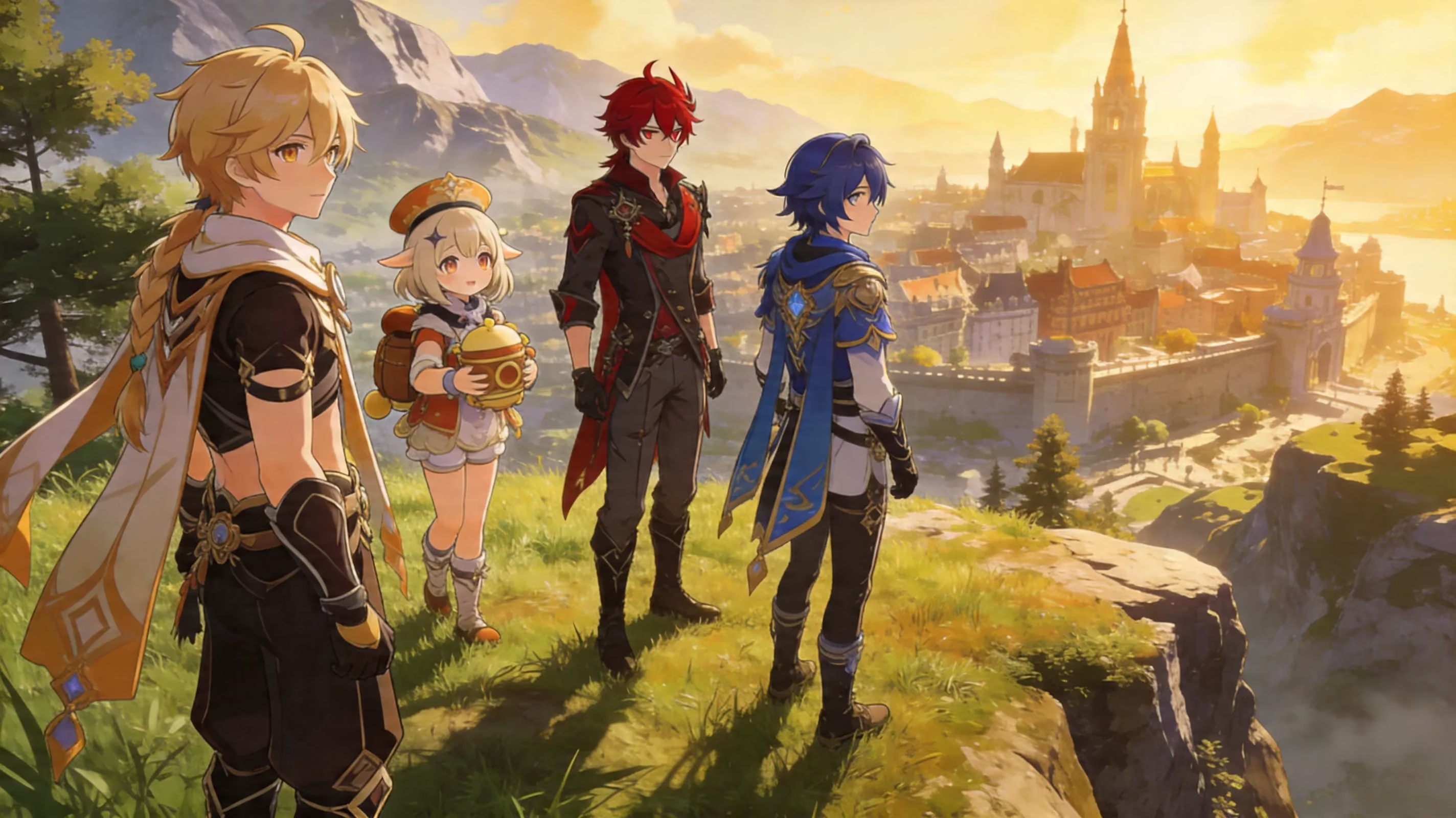
A Real Fan Always Speaks Ill of Genshin Impact Meaning
The phrase was never some official slogan or polished community manifesto. It grew out of player spaces naturally, mostly because veterans kept noticing the same pattern: the sharpest, most specific criticism almost always came from people who actually knew the game inside and out. Someone who quit months ago might just say, "it's a gacha game." A committed player, on the other hand, can tell you exactly why a domain feels resin-inefficient, why a constellation is overloaded, or why a banner's pull value falls apart once you compare it to current meta options.
There is also a social function to the phrase. Genshin communities tend to swing between two extremes:
-
Blind defense: every complaint gets dismissed as negativity or doomposting
-
Pure ragebait: every patch is treated like the end of the game
That is where this meme lands in a much more grounded way. A real fan always speaks ill of Genshin Impact basically means that honest criticism is part of caring. If you have invested enough time, money, and attention into a game, you are going to notice the gap between what it is and what it could be.
That love-hate dynamic is not unique to Genshin, of course. MMO players do this. Long-running gacha communities do this. Any live-service game with years of updates behind it will eventually produce a playerbase that sounds half in love and half exhausted. Genshin just does it on a much bigger scale, with a massive global audience, strong character attachment, and a monetization model that makes every balance decision feel personal.
And that last part matters. When players complain, they are not always reacting to numbers in a vacuum. They are reacting to time spent saving Primogems, to emotional investment in a character, and to the feeling that one weak release can waste months of planning. That is why people still log in while criticizing the game nonstop. They are frustrated, yes, but they are not detached.
Genshin Impact Problems Real Fans Keep Calling Out
There are a few recurring issues that dedicated players keep bringing up, and not without reason. Some are about balance. Some are about monetization pressure. Others are just quality-of-life misses that feel bizarre this far into the game's lifespan.
Meta pressure and pull anxiety
Even in a mostly solo game, pull pressure is real. Players may say "just pull who you like," and in many cases that is still good advice, but the moment endgame checks get tighter, the conversation changes. Suddenly, every banner becomes a value calculation: damage ceiling, team flexibility, constellation bait, future synergy, and whether skipping now will hurt later.
That creates a kind of low-level anxiety around every patch. If you are free-to-play or a light spender, one bad banner decision can lock you out of future options for months. Real fans call this out because they feel it directly.
The Varka backlash and weak launch problem
One of the clearest examples in early 2026 was Varka. After being teased all the way back near the game's 2020 launch, Mondstadt's Grand Master finally became playable in the February 2026 update. On paper, everything was lined up for a huge release. He had years of lore buildup, a likable personality, ties to the newly introduced Nod-Krai region, and an event that did a solid job making players care.
Then the kit numbers came out, and the mood shifted fast.
According to major fan-run wish tracking data, the Varka and Flins banner period saw around 103,575 players make just under 6.4 million wishes total. That was one of the weakest pull totals of that version cycle. Columbina's debut banner just weeks earlier pulled in more than 27 million wishes from 262,848 players. Put simply, for every wish spent on Varka, about four went to Columbina.
That says a lot. It shows how badly the game can fumble when narrative hype and gameplay value are not aligned. A character can be beloved in the story, heavily marketed, and emotionally important to players, but if the kit does not hold up, many people will still skip. Fans keep criticizing this because it keeps happening.
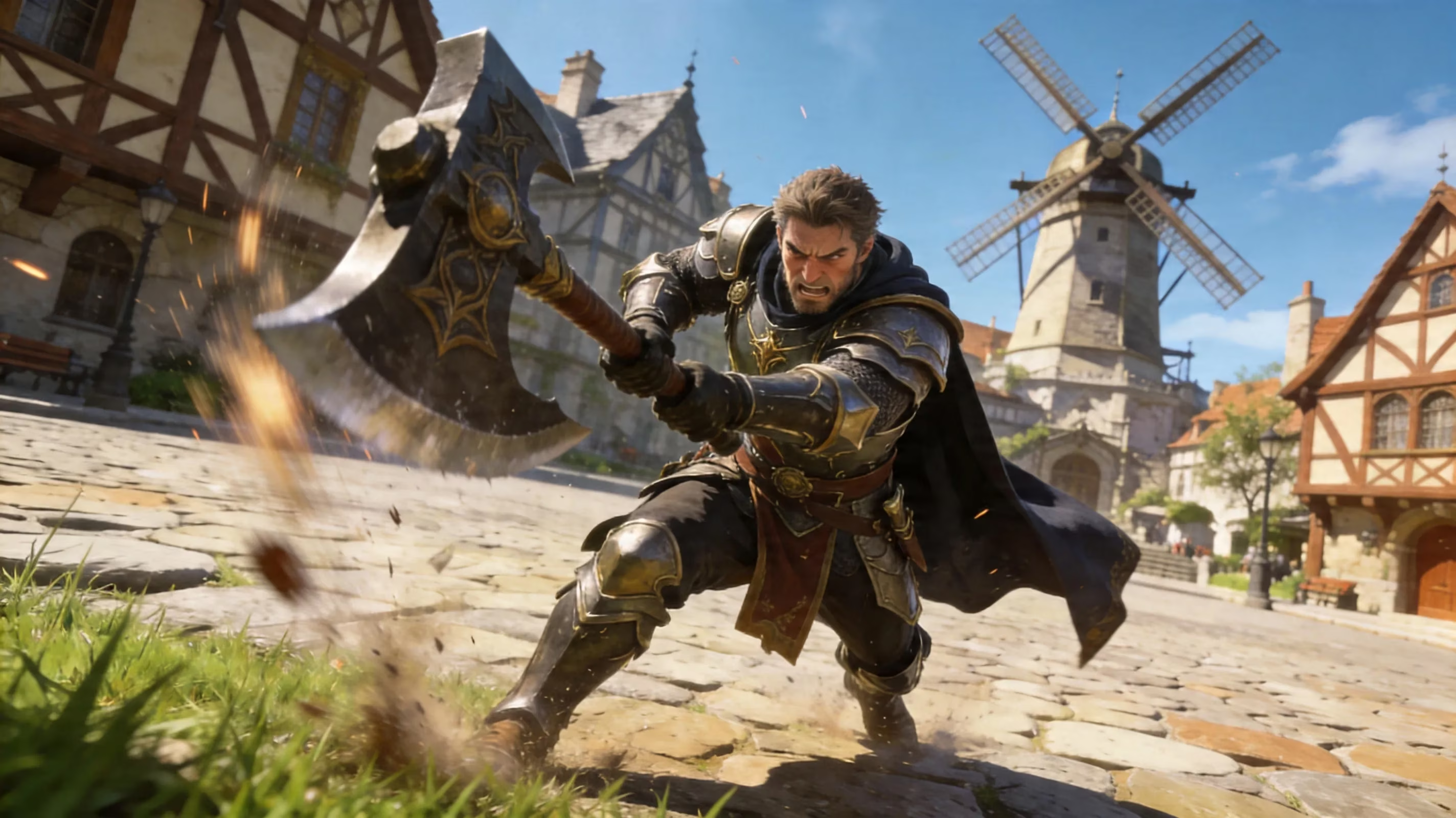
Lunar Reaction roster lock
Nod-Krai introduced the Lunar Reaction system, and this is where another major complaint started gaining traction. Unlike earlier regional mechanics such as Fontaine's Pneuma/Ousia or Natlan's Nightsoul, Lunar Reactions in mid-2026 still feel heavily locked behind specific five-star units from that region. There are far fewer accessible workarounds, and players noticed that immediately.
If you like saving for favorites instead of chasing every new mechanic, this is a problem. A lot of players are worried that modes like Spiral Abyss and Stygian Onslaught could eventually lean hard enough into Lunar interactions that full clears start feeling unrealistic without those units.
The Moonsign system only added to that discussion. Some players have argued that enough Moonsign investment should eventually let characters like Jahoda, Aino, or Illuga access Lunar functionality too. That would make the system feel more open and less like a soft paywall. HoYoverse has not really clarified where this is going long term, and that uncertainty has kept the criticism alive.
Loadout, UI, and QoL misses
This one stings because it feels so avoidable. Version 5.7 was supposed to bring what many players hoped would finally be a real artifact loadout system. After years of manually swapping five pieces one by one, the community was ready for saved builds, quick switching, and actual team prep convenience.
What arrived was... not really that.
The new feature improved filtering and made sorting by main stat and sub-stat easier, which is useful, sure. But it still did not let players save full builds and instantly move them between characters. You still have to equip artifacts slot by slot. For a game this old, that felt way more underwhelming than it should have.
The same goes for UI annoyances like the Patch 5.4 map notification system, which keeps pushing quest reminders in the top-left corner with no proper toggle. On mobile, especially, that kind of clutter gets old fast.
Here are the complaints real fans keep repeating most often:
-
Artifact management is still too manual
-
UI notifications are intrusive
-
New systems often launch half-finished
-
QoL requests take far too long to land
-
When they do land, they sometimes solve only part of the problem
That is not random negativity. It is long-term frustration from people who have been asking for the same fixes for years.
Why Genshin Impact Still Keeps Fans Hooked
For all the criticism, Genshin still has a grip on its playerbase that a lot of live-service games would kill for. And honestly, it is not hard to see why.
Elemental combat sandbox
The combat system is still one of the game's biggest strengths. Reactions like Vaporize, Melt, Hyperbloom, Aggravate, and now Lunar Reactions are not just flashy effects. They sit on top of a surprisingly deep system involving internal cooldowns, elemental gauge interactions, rotation timing, and buff windows.
That is what makes the game work for different kinds of players. If you are casual, you can throw Pyro into Hydro and enjoy big numbers. If you are more invested, you can optimize exact rotation order, frame timings, and reaction ownership. Both playstyles function. Very few live-service RPGs manage that balance this well.
It also helps older units stay relevant. A well-built Neuvillette, Hu Tao, or Raiden Shogun does not instantly become dead weight just because a newer five-star shows up. Team synergy still matters a lot, and that gives the roster more staying power than many competing games.
From Mondstadt to Nod-Krai
World attachment is another huge reason players stay. Genshin is not just a combat treadmill; it is a place people have spent years returning to. Mondstadt, Liyue, Inazuma, Sumeru, Fontaine, Natlan, and now Nod-Krai all carry their own identity, and players build real emotional associations with them over time.
That matters more than banner charts can show. People remember where they started. They remember the first city theme that clicked with them, the first Archon quest that landed, the first character they saved months for. By the time you get from Mondstadt to Nod-Krai, you are not just progressing through regions. You are building attachment.
And that is exactly why criticism gets so intense. When a character like Varka underperforms, players are not reacting to one weak unit in isolation. They are reacting to years of buildup and expectation. The disappointment hits harder because the investment was real.
Character loyalty over tier lists
A lot of players stick with Genshin because it still lets them value favorites over spreadsheets. Yes, meta exists. Yes, some teams are clearly stronger. But outside of the hardest content, the game is still pretty forgiving.
You can run a team because you like the characters. You can main someone who is no longer top-tier. You can build around aesthetics, story attachment, or comfort instead of pure output. That flexibility keeps people around, especially players who are tired of games where every roster choice feels mandatory.
Solo-friendly live-service loop
This is one of Genshin's most underrated strengths. Because there is no PvP ladder and no ranked pressure, off-meta choices do not come with social punishment. Nobody is kicking you from a competitive queue because your favorite team is weird. If your Diluc-Barbara setup is not optimal, that is your business.
If your Diluc-Barbara setup is not optimal, that is your business.
That solo-friendly structure makes the game much easier to live with long term. You can engage at your own pace, skip what you do not care about, and still feel like your account is yours. Add in regular updates and cross-platform convenience, and it makes sense why so many players stay even while complaining loudly.
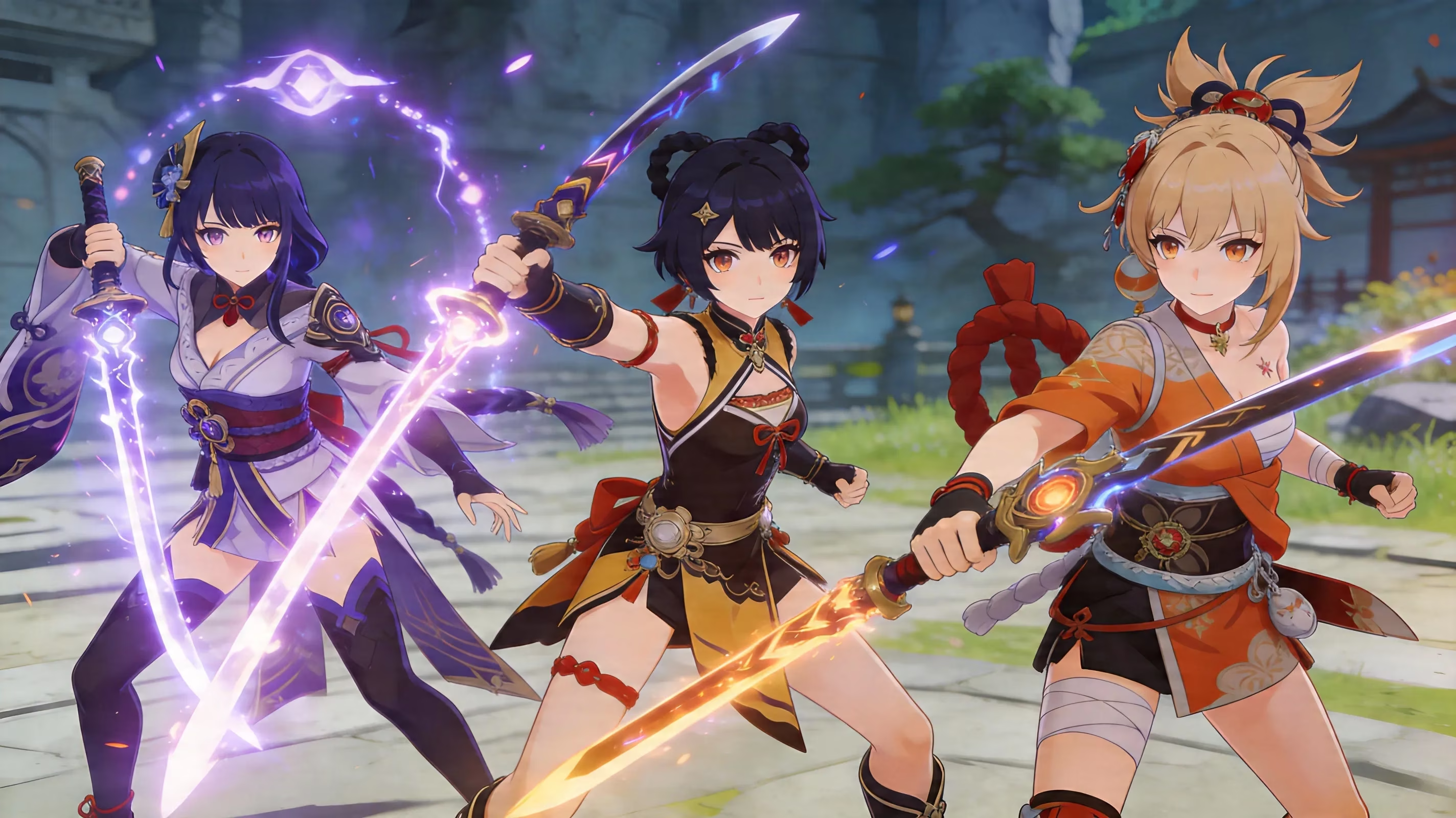
Meta Burnout and Character Strength in Genshin Impact
A lot of Genshin frustration really comes down to burnout around strength expectations. Not every player wants the same thing from the game, but the community often talks as if everyone should chase the same standard.
Spiral Abyss, Stygian checks, and what endgame really asks for
A useful way to look at account value is the old tall vs wide distinction.
A tall account invests hard into a smaller set of characters: constellations, signature weapons, optimized artifacts, and polished rotations. A wide account spreads resources across more units, more elements, and more team types. Genshin's endgame modes reward these approaches differently, which is why so many arguments about "must-pull" characters end up talking past each other.
| Endgame Mode | Primary Check | DPS Threshold (approx.) | Reward Type |
|---|---|---|---|
| Spiral Abyss Floor 12 | Vertical investment | ~50,000 | Primogems (permanent) |
| Stygian Onslaught Hard | Entry-level DPS | ~9,167 | Artifact farming access |
| Stygian Onslaught Dire VI | Peak optimization | ~248,000+ | Cosmetic weapon skins |
| Imaginarium Theater | Roster width | Varies | Primogems + materials |
That table explains a lot of the burnout. Spiral Abyss Floor 12 asks for solid investment, but it is still nowhere near the level of optimization demanded by Stygian Onslaught Dire VI, where community estimates put final boss DPS requirements above 248,000 per second. A standard Abyss clear is closer to 50,000 DPS. That is a massive gap.
Meanwhile, Imaginarium Theater flips the script and rewards roster breadth instead. If you only built two premium teams, you may struggle. If you have a broader account with multiple usable four-stars and niche five-stars, it gets easier.
The important part is this: all Primogem rewards in Stygian Onslaught are tied to Normal, Advancing, and Hard. Dire difficulty only gives cosmetic weapon skins. So if you cannot clear the hardest tier, you are not losing pull currency. You are missing cosmetics, not banner income.
That design choice matters a lot. It lowers the sense that the mode is fully whale-gated, even if the debate is still ongoing over whether Dire should be realistically clearable at C0 R1 with strong enough execution.
Favorite picks vs meta teams
This is where many players burn out. They start by building favorites, then hit a wall in endgame, then feel pressured to pivot into whatever the current top teams are. Suddenly the game stops feeling personal and starts feeling transactional.
Realistically, both approaches can coexist. You can keep your favorite characters as your core identity while still building one or two stronger teams for harder checks. The problem starts when every banner gets framed as mandatory and every non-meta pull gets treated like a mistake.
That mindset is exhausting. It also ignores how much value players get from simply enjoying the units they use every day.
Pull value after pity changes
Version 5.0 made one of the more meaningful monetization-side improvements by lowering the guaranteed five-star pity ceiling from 180 wishes to 160. On paper, that is just a system adjustment. In practice, it changes how players think about risk.
For anyone who has ever been dragged to hard pity repeatedly, that lower ceiling matters a lot. It reduces worst-case cost, and maybe more importantly, it makes planning feel less punishing. In 2026, with both Apple's App Store and Google Play requiring clearer loot box disclosure labeling for gacha games, players also have more transparency around how these systems work.
Research from 2025 suggested that players who understand pity mechanics tend to spend less per session, which is interesting because it shows that transparency does not necessarily hurt long-term engagement. If anything, it can make players feel safer and more willing to stay invested.
How Real Fans Criticize Genshin Impact Better
Not all criticism is equally useful. Some of it helps. Some of it is just noise. The difference usually comes down to whether the player is trying to say something specific or just farm reactions.
Useful feedback, not ragebait
The best criticism tends to separate issues clearly instead of mashing everything together. That means treating these as different conversations:
-
Kit and mechanical balance
-
Story and character writing
-
Monetization and system pressure
If Varka's numbers are weak, that is one argument. If his story quest is good, that is another. If Lunar Reactions create unhealthy banner pressure, that is a third. Once you mix all of those into one angry post, the point usually gets lost.
Useful feedback is specific. It points to numbers, design friction, or actual player experience. Ragebait just tries to make everything sound catastrophic.
Separate kit, story, and monetization
This is probably the single biggest upgrade players can make in how they talk about the game. A character can be mechanically disappointing and still be narratively great. A region can be beautiful while its progression system feels restrictive. A patch can include strong story content and still miss badly on QoL.
Keeping those categories separate makes criticism more credible. It also makes discussion less miserable.
Skip banners without quitting
A lot of players need this reminder more than they think. You do not have to pull every hyped unit, and you definitely do not need to treat every skip as some dramatic break from the game. One of Genshin's best traits is that it gives you room to opt out.
If a banner is weak, skip it. If a character does not fit your account, skip it. If you are saving for someone else, that is fine. You are not falling behind in some irreversible way every time you pass on a release.
That kind of restraint is actually one of the healthiest habits long-term players develop.
Build fun teams intentionally
There is a difference between playing casually and playing carelessly. Real fans who stay engaged without burning out usually make intentional choices. They know which endgame mode they care about, what level of investment they are aiming for, and how much they are willing to spend or save.
A few habits help a lot:
-
Know whether your account is tall or wide
-
Keep emergency pity savings if possible
-
Do not panic-pull version by version
-
Build at least one team for comfort and one for harder checks
-
Treat character collection like a long rotation, not a sprint
None of this is revolutionary. Veteran players have been saying it forever. But newer players still get caught in the same cycle every patch, so it is worth repeating.
The healthiest version of the meme is not "complain about everything." It is more like this: care enough to be specific, stay honest about what bothers you, and do not let the game's pressure systems decide how you are supposed to enjoy it.
Conclusion
A real fan always speaks ill of Genshin Impact sounds harsh, but the phrase only works because there is real affection behind it. Players who criticize the game are often the ones most invested in seeing it improve. They are not blind defenders, and they are not always doomposters either. Most of the time, they are just people who know exactly how good Genshin can be and get frustrated when it settles for less.
That is what makes the phrase stick. Criticism is not the opposite of fandom here; in a lot of cases, it is proof of it. So if you love Teyvat, complain when the game deserves it, skip what is not worth your Primogems, and enjoy the world on your own terms.
Comments